
Greek Literary Papyri
The Ancient Books Website
The Ancient Books Website (ABW) joins a long tradition of open- access tools for papyrological research. The website provides data complementary to those in tools like the Leuven Database of Ancient Books (LDAB), now part of Trismegistos (TM), and the Digital Corpus of Literary Papyri (DCLP). The data captured here are focused on two areas: (1) reconstruction of the physical details of each literary papyrus, and (2) analysis of the scribal features.
Foundational to the project is that these data are culled not from editions, but from independent analysis based on autopsy or high-resolution images. The analysis is facilitated by a suite of dedicated software, and for known works makes use of machine-readable texts from the TLG project.
Our Data
Content & Scope
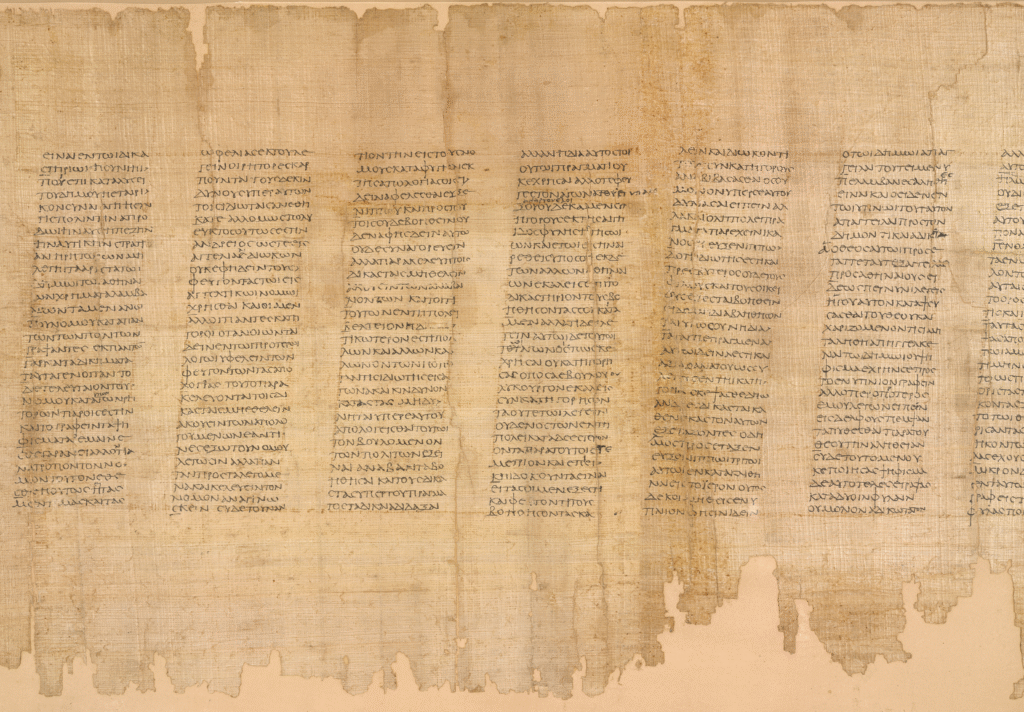
Bookrolls
For papyrus bookrolls, you can use the Search tab to access data for individual papyri by TM number or content, and the Browse tab to see the data in sortable tabular format.
Physical features. The website provides measurements for width and height (measured or calculated) for features like column, intercolumn, roll, letters, and vertical spacing.
Scribal features. So far, the website provides synoptic analysis of the punctuation, and of scribal usage for nu-movable and iota adscript. We will be adding to these data over time.

Early Codices
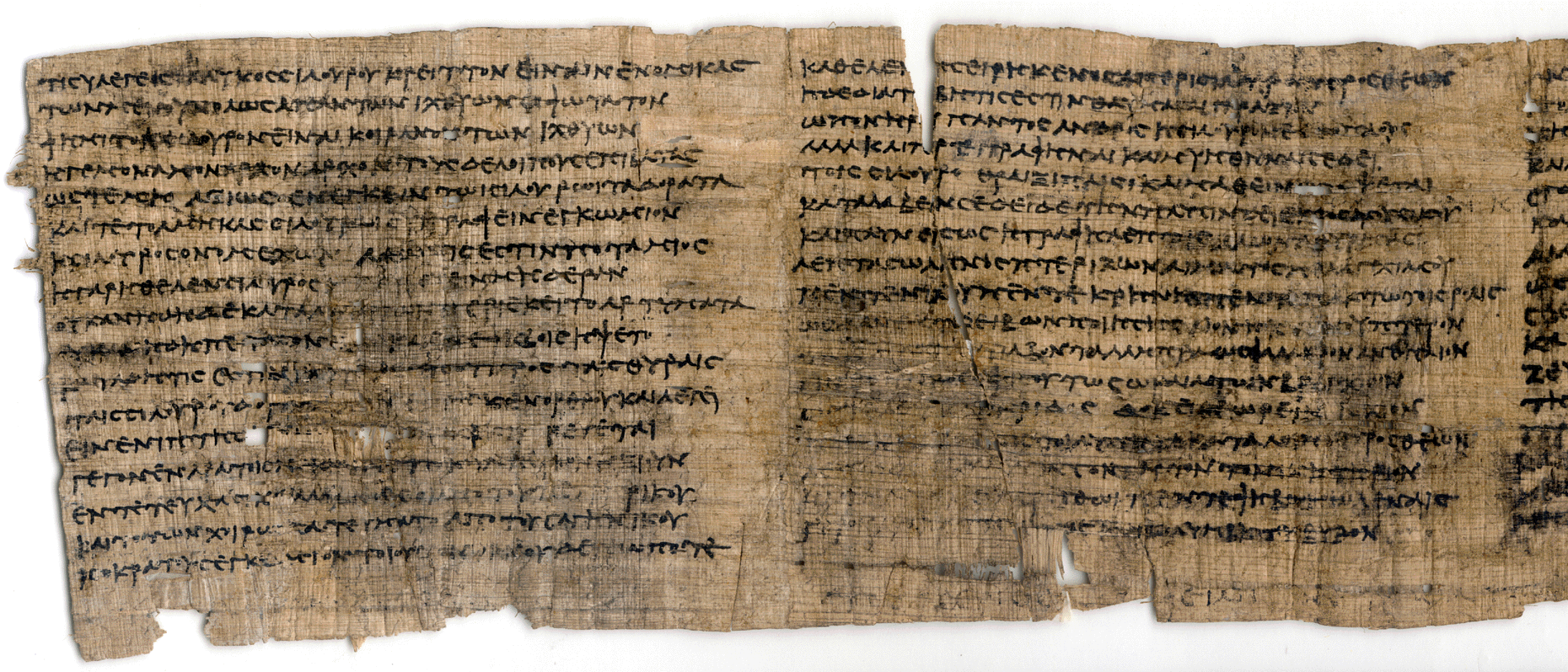
Over the past years, we have accumulated extensive data for all codices of known works (and some unknown works) for which a third-century or earlier date is claimed by scholars. Phase II of the website project will be the release of these data in 2026.
Origins & Future
The Bookrolls side of the project is primarily the work of William A. Johnson, with important additions by Nicholas Wagner. The core dataset for the physical features are those that inform Johnson’s 2004 monograph, Bookrolls and Scribes in Oxyrhynchus (Toronto University Press); the core dataset for the scribal features are those that inform Johnson’s 2025 volume, W. A. Johnson, Punctuation, Iota Adscript, and Nu-movable in Ancient Literary Bookrolls (Leuven, TOP 10). To those data have been added additional literary papyri, so far mostly by Wagner. The full dataset resides in a Filemaker database. What the website presents is curated, synoptic data drawn from the full dataset. The methodologies for accumulating these data are described and discussed in Johnson’s 2004 and 2025 publications.
The Codices side of the project was started by Johnson in 2010 with initial accumulation of bibliography and high-resolution images for many of the targeted 350 codices with the assistance of Gabrielle Stewart and Mason Barto. Those early efforts formed the foundation for launch of the Early Codices Project in 2021, a concerted collaboration by Wagner (who has done the majority of the data entry) and Johnson (who wrote the software that facilitates the data entry and reconstructions of the codices), consisting now of a full dataset for 200 codices. Those data also reside in a Filemaker database. Both Wagner and Johnson carefully review and verify the data for each codex before tagging the records completed. That verification task is our present focus, after which we will turn to the curation of the synoptic data. We expect to add the first tranche of codices data to the Ancient Books Website in 2026.
We plan for the website to be an ever-expanding, continuing resource.